Over the last quarter-century, the landscape of equipment rental technology has transformed beyond recognition. What was once a largely manual, paper-heavy sector has evolved into a highly integrated digital ecosystem. Today, effective rental fleet management and equipment lifecycle management are the backbone of industry profitability. As we reflect on this rapid shift, it is clear that the move from disjointed operations to intelligent, automated service support and parts procurement has fundamentally redefined how rental operators do business. The journey from isolated depots to connected, data-driven fleets sets the stage for an exciting future.
From Siloed Systems to Connected Ecosystems
Back in 2000, the equipment hire industry was vastly different. Compact discs were only just replacing microfiche, operational manuals were tightly guarded by technical departments, and communication relied heavily on basic Electronic Data Interchange (EDI). Each manufacturer and dealership operated within its own closed system, leaving rental companies to navigate a disjointed maze to find the information they needed.
Recognising this inefficiency, platforms like the SmartEquip Network emerged to create an intelligent industry-wide “middleware” layer. By dynamically connecting rental companies with hundreds of suppliers, matched to each make, model, and serial number in their fleets, the industry began to break down these silos. This shift proved that true efficiency required a real-time flow of information tied precisely to the make, model, and serial number of every individual asset.
The Operational Shift: Revolutionising Rental Fleet Management
For rental operators, this technological leap grounded abstract digital concepts into concrete operational value. The daily reality of maintaining a fleet underwent a radical shift:
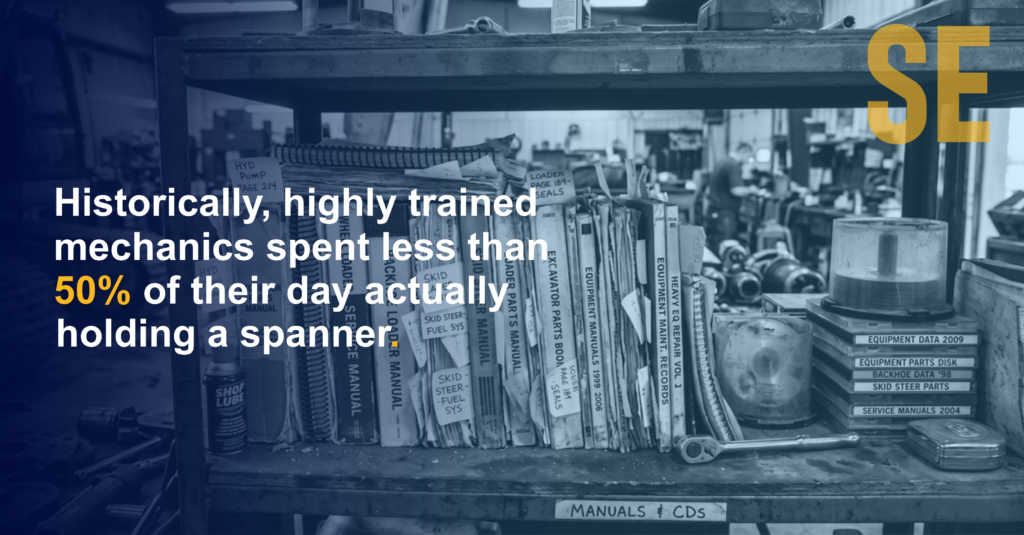
- From Manual to Integrated Parts Procurement: Historically, highly trained mechanics spent less than 50% of their day actually holding a spanner. They lost countless hours hunting down paper manuals and calling dealers to verify superseded parts. Today, serial-number-specific digital catalogues intelligently “find” each technician and respective repair event and then automate the entire procurement process, effectively doubling technician “wrench time”.
- From Siloed to Connected Ecosystems: Rather than operating isolated repair bays, modern depots now exist within one interconnected global network where data flows seamlessly between OEMs, dealers, and the back-office ERP systems.
- From Reactive to Predictive Maintenance: Instead of waiting for a machine to break down, operators are increasingly leveraging sensor data and integrated platforms to monitor equipment health in real-time, anticipating service needs before they result in costly downtime.
Navigating European Complexity and Equipment Lifecycle Management
Nowhere is this evolution more evident than across the UK and Europe. As we head to Maastricht, The Netherlands in June for the ERA Annual Convention, IRE and APEX we are reflecting on how pan-European leaders like Loxam and Boels manage multi-country fleet complexity which requires robust, scalable systems that can handle diverse regulatory and operational demands.
As these equipment fleets span well over a dozen countries, organisations like the European Rental Association (ERA) have played a crucial role in bridging multi-regional differentiation. It has also set the stage for technology platforms that support comprehensive equipment lifecycle management across different languages, currencies, and regional supplier arrangements and networks, to maintain margin and competitive advantage across this increasingly complex market. SmartEquip, for instance, has grown into a global industry standard utilised by the world’s five largest rental fleets across Europe, North America, and Japan, to unify and streamline equipment support across exceptionally diverse markets.
Scaling Growth Across North America and Asia-Pacific
The largest rental companies across Europe, North America and Asia-Pacific are continuing to be defined by massive scale and ongoing rapid growth. North America remains the world’s largest equipment rental market, heavily fuelled by robust infrastructure spending and the consolidation of mega-fleets. Conversely, the Asia-Pacific (APAC) region stands as the fastest-growing market globally, driven by rapid urbanisation and large-scale infrastructure projects, with Japan having the longest-standing rental tradition and highest rental penetration ratio across all three regions – ever larger and diverse equipment fleets demand ever more technology support to drive ever growing fleet utilisation.
The SmartEquip Network has become the standard across these diverse landscapes—powering the operations of North American giants like United Rentals and Sunbelt Rentals, alongside Japanese rental fleet giants like Aktio, Nishio, and Nikken. This global adoption proves the universal adaptability of digital workflow solutions.
AI and the Future of Service Support and Parts Procurement
As we look toward the future, the next major leap in equipment rental technology will center on Artificial Intelligence and its ability to once again radically shift service efficiency and improve equipment utilisation through intelligent service support and procurement.
The evolution from microfiche to intelligent, increasingly predictive networks proves that embracing new technology is the fastest path to greater efficiency and profitability. As the industry looks ahead to the next era of rental, conversations like these will take centre stage at the upcoming ERA Convention and IRE. If you’re attending, find SmartEquip at stand 2515 from June 2 – 4, 2026 to discuss how we can help you build the future of your fleet or schedule a 1:1 demo with one of our experts.
AI, intelligent service support, and connected procurement are redefining the future of the equipment rental industry. The question is no longer if the industry will evolve — it’s whether your operation is prepared to evolve with it.
Discover how SmartEquip is helping fleets build the next generation of operational efficiency.